
The History of Personality Colors: From Hippocrates to True Colors
Personality colors feel modern, the kind of thing you meet in an online quiz or a team-building workshop. The ideas underneath them are some of the oldest in Western thought. This page traces the story in order, with a source for every date and name. For how the systems work today, see Theory.
Timeline at a glance
Four humours and four temperaments
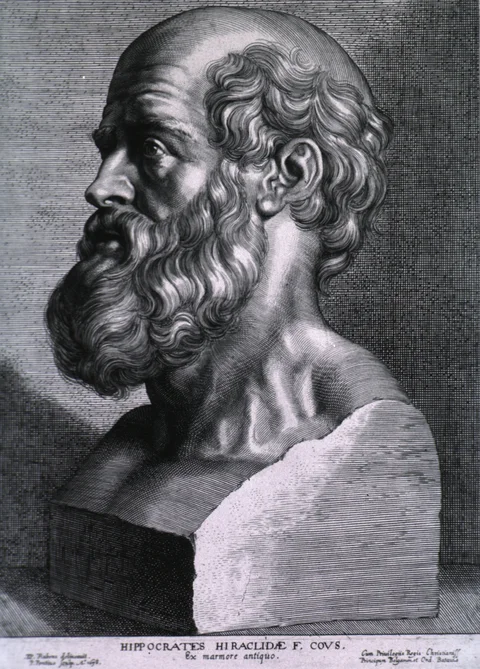
The Greek idea was medical. On the Nature of Man describes health as the right balance of four humours and links each to a season: blood to spring, yellow bile to summer, black bile to autumn and phlegm to winter [3]. Although we often say "Hippocrates' four humours," scholars generally attribute this particular treatise to Polybus, Hippocrates' student and son-in-law [3].
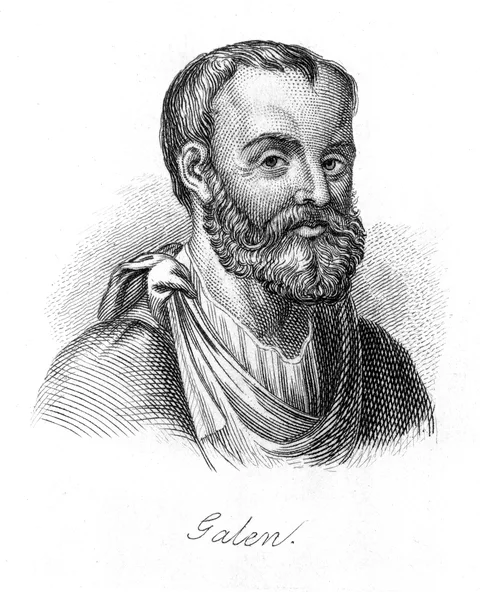
Galen, a Greek physician working in the Roman Empire, made the system enormously influential. Born in Pergamon in 129 CE, he wrote prolifically on anatomy, physiology and medical theory [4]. Galen aligned the humours with the four elements and the qualities hot, cold, wet and dry, and argued that a person's mixture shaped their temperament [5]. In medieval and early modern Europe the four temperaments, sanguine, choleric, melancholic and phlegmatic, became everyday words for character [2].
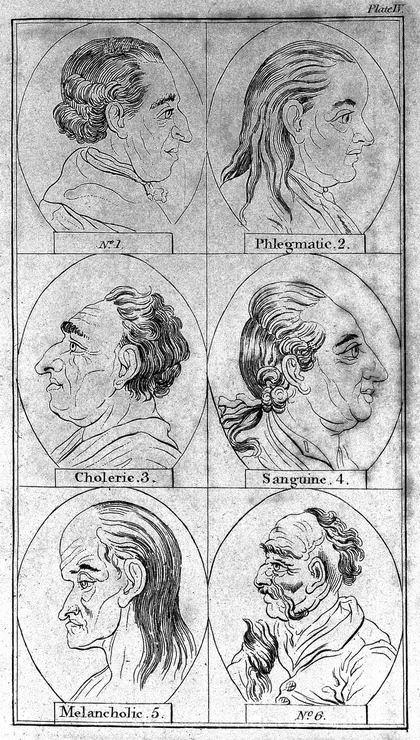
The humoral theory of disease did not survive modern medicine. The words did. "Sanguine" still means optimistic and "phlegmatic" still means unflappable. And the habit of sorting people into four was handed down to almost every later system. The illustrated Essays on Physiognomy by Johann Caspar Lavater, published in English in the 1790s, still showed the four temperaments as faces.
When color met character
For most of history the temperaments had nothing to do with color. The link was drawn by artists and thinkers who were studying color itself. Newton's Opticks (1704) placed the colors of the spectrum around a circle, the ancestor of every color wheel [6][7]. A century later, Goethe challenged Newton's physics and focused instead on how colors are experienced. In 1798–99 he and Friedrich Schiller painted the Temperamentenrose, a ring of twelve colors annotated with occupations and grouped by the four temperaments [8]. Goethe's 1810 Theory of Colours devoted a section to the "sensory and moral effect" of colors [9].
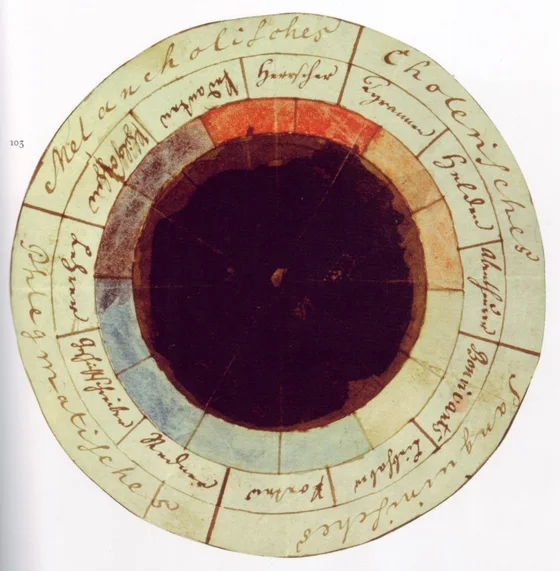
Goethe's color theory is not accepted physics, but its idea that colors carry emotional and moral meaning fed straight into 20th-century color psychology.
The 20th century: tests and trainings
Marston and DISC (1928). William Moulton Marston described four patterns of emotional behavior, Dominance, Inducement, Submission and Compliance, in Emotions of Normal People [10][11]. He never built a test. In the 1950s Walter V. Clarke developed a personnel-selection instrument whose four factors were consistent with Marston's model [13][14], and in the 1970s John Geier created the Personal Profile System, the first published DiSC assessment [14]. Color versions of DISC came later and differ by vendor (see Theory).
Lüscher (1947). Max Lüscher, born in Basel in 1923, presented an early version of his color test at the first World Congress of Psychology in Lausanne in 1947, then completed his doctorate at the University of Basel in 1949 [12]. His test asked people to rank colored cards by preference, and it became a popular phenomenon after the English edition appeared in 1969 [15]. Lüscher died in 2017 [12]. Its scientific validity has been widely questioned (see Theory).
Keirsey and True Colors (1978). David Keirsey and Marilyn Bates published Please Understand Me in 1978, reviving four temperaments in the language of modern type theory [16]. That same year Don Lowry, impressed by Keirsey's work, founded True Colors, which renamed the four temperaments Gold, Blue, Green and Orange so that children and adults could remember them easily [17][18].
Hartman's Color Code (1987). Taylor Hartman's The Color Code appeared in 1987 [19], and a Simon & Schuster edition followed in 1998 [21]. Hartman sorted people by core motive into Red (power), Blue (intimacy), White (peace) and Yellow (fun).
Insights Discovery (1993). Insights, founded in 1993 by Andi Lothian and his son Andy, built a four-color model (Fiery Red, Sunshine Yellow, Earth Green, Cool Blue) on Carl Jung's typology [20].
The research era
Since the 1990s academic personality psychology has largely settled on trait models such as the Big Five, which measure tendencies on continuous scales rather than sorting people into types [24]. Color research has moved on too, from "what does your favorite color say about you" toward how people actually associate colors with objects and emotions. A 2010 study proposed that people like colors in proportion to how much they like the things associated with them [22], and a 2020 survey of 4,598 people across 30 nations found strong cross-cultural similarity in color-emotion associations [23].
Today's color quizzes, ours included, borrow the memorable language of this long tradition. We think that is fine as long as everyone is clear about what they are: conversation starters with a rich history, not scientific instruments. Ready to try one? Take our quiz.
- [1] Encyclopaedia Britannica, "Hippocrates." britannica.com/biography/Hippocrates
- [2] Encyclopaedia Britannica, "Humour (ancient physiology)." britannica.com/science/humor-ancient-physiology
- [3] J. Jouanna, "The Legacy of the Hippocratic Treatise The Nature of Man," in Greek Medicine from Hippocrates to Galen, Brill, 2012. brill.com (PDF)
- [4] Encyclopaedia Britannica, "Galen." britannica.com/biography/Galen
- [5] Encyclopaedia Iranica, "Humoralism." iranicaonline.org/articles/humoralism-1
- [6] I. Newton, Opticks, London, 1704 (scan). archive.org/details/optickstreatise00newta
- [7] Wikimedia Commons, "Newton's colour circle." commons.wikimedia.org
- [8] Klassik Stiftung Weimar, "Die Temperamentenrose." klassik-stiftung.de
- [9] Wikipedia, "Theory of Colours." en.wikipedia.org/wiki/Theory_of_Colours
- [10] W. M. Marston, Emotions of Normal People, 1928 (HathiTrust record). catalog.hathitrust.org/Record/000387604
- [11] DiSC Profile, "History of DiSC." discprofile.com
- [12] Max Lüscher Stiftung, "Biography." luscher-color.com/en/biography
- [13] W. V. Clarke, "The Construction of an Industrial Selection Personality Test," Journal of Psychology 41(2), 1956. doi.org/10.1080/00223980.1956.9713011
- [14] Everything DiSC, "Our Story." everythingdisc.com/our-story
- [15] Wikipedia, "Lüscher color test." en.wikipedia.org/wiki/Lüscher_color_test
- [16] Internet Archive, Please Understand Me by David Keirsey and Marilyn Bates (Prometheus Nemesis, 1978). archive.org/details/pleaseunderstan00keir
- [17] True Colors Workshops, "About True Colours." truecolorsworkshop.com
- [18] Wikipedia, "True Colors (personality)." en.wikipedia.org
- [19] Goodreads, The Color Code by Taylor Hartman (first published 1987). goodreads.com
- [20] Insights, "Insights Discovery: Validating the System" (PDF). insights.com (PDF)
- [21] Internet Archive, The Color Code, Simon & Schuster, 1998. archive.org/details/colorcode00drta
- [22] S. E. Palmer & K. B. Schloss, "An Ecological Valence Theory of Human Color Preference," PNAS 107(19), 2010. doi.org/10.1073/pnas.0906172107
- [23] D. Jonauskaite et al., "Universal Patterns in Color-Emotion Associations...," Psychological Science 31(10), 2020. doi.org/10.1177/0956797620948810
- [24] R. R. McCrae & O. P. John, "An Introduction to the Five-Factor Model and Its Applications," Journal of Personality 60(2), 1992. doi.org/10.1111/j.1467-6494.1992.tb00970.x