
From Goethe's Rose of Temperaments to Online Quizzes: How Color Became Personality
The four temperaments are ancient, but for most of their history they had no colors. Sanguine was not red and melancholic was not blue. So when, and how, did color and character get tied together? The answer runs through a physicist's prism, a poet's watercolor, a Swiss psychologist's cards and a California workshop. Here is the story.
Newton puts color in a circle (1704)
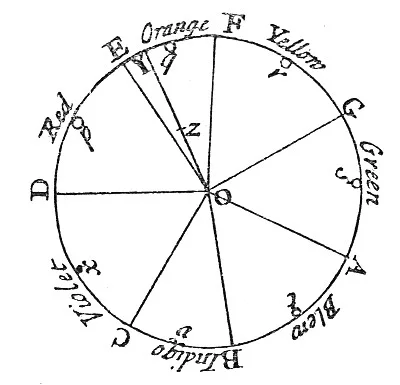
Isaac Newton's Opticks, first published in 1704, reported his experiments splitting white light with prisms and arranged the spectrum's colors around a circle [1][2]. Newton's circle was physics, not psychology, but it gave European thinkers a powerful new picture: colors as an ordered system with opposites and neighbors. Every later attempt to map colors onto people borrows that structure.
Goethe and Schiller's rose of temperaments (1798–99)
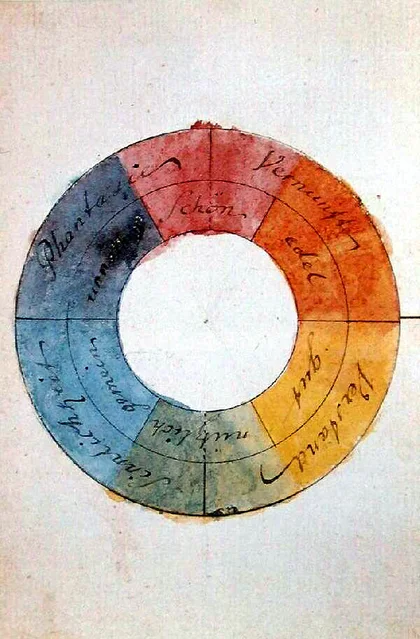
Johann Wolfgang von Goethe, already famous as a poet, spent decades studying color and became convinced that Newton had missed the most interesting part: how colors are experienced. In 1798 and 1799 he and his friend, the playwright Friedrich Schiller, created a remarkable watercolor now known as the Temperamentenrose, the "rose of temperaments" [3].
The rose is a ring of twelve colored segments. Each segment is linked to human occupations or character types (rulers, heroes, philosophers, lovers, poets and others), and the ring is grouped into the four classical temperaments [3]. For the first time we can point to, colors and the temperaments sit on the same diagram.
Goethe went on to publish Zur Farbenlehre (Theory of Colours) in 1810, including a section on the "sensory and moral effect" of colors, essentially an early theory of color psychology [4]. He also produced a color circle "for symbolizing the human mind and spirit," which today hangs in many art history lectures.
Goethe's physics did not hold up, but his insistence that colors carry emotional and moral meaning influenced painters, designers and, eventually, psychologists.
The 20th century: color as a test (1947)
The next big step came from Basel. Max Lüscher, born there in 1923, became fascinated by how people respond to colors. According to the foundation that preserves his work, he presented an early form of his color test at the first World Congress of Psychology in Lausanne in 1947 and completed his doctoral thesis at the University of Basel in 1949 on color as a psychological means of examination [5].
The Lüscher test flipped Goethe's idea around: instead of colors affecting your mood, your preferences among colors would reveal your state of mind. In its short form you rank eight colored cards. After The Lüscher Color Test was published in English in 1969, it became a popular sensation [6]. Researchers have since questioned its validity [7], but it made "your color choices reveal you" a mainstream idea.
Colors as friendly labels (1978 onward)
A different branch of the story uses color not as a test stimulus but simply as a name. In 1978 David Keirsey and Marilyn Bates published Please Understand Me, which described four temperaments derived from Myers-Briggs type theory [8]. That same year, Don Lowry founded True Colors, translating Keirsey's four temperaments into Gold, Blue, Green and Orange so that children and adults could remember them easily [9]. True Colors spread through schools, youth programs and workplaces.
In 1987 Taylor Hartman published The Color Code, which sorted people by core motive into Red, Blue, White and Yellow [10]. Color versions of DISC, a model rooted in William Moulton Marston's 1928 Emotions of Normal People, became common in corporate training [11]. Insights Discovery, founded in 1993, built a four-color model on Carl Jung's typology [12].
What all of these share is a practical insight: colors make abstract personality ideas easy to remember and safe to talk about. "I'm a bit of a Green" is less loaded than "I'm introverted and analytical."
The internet era
Online, color quizzes multiplied. They are cheap to build, fun to share and easy to understand. Most are entertainment, and many recycle Barnum statements that fit almost anyone (see why quizzes feel accurate). Meanwhile research has moved in a more careful direction, studying how colors and emotions are associated across cultures [13] and why people prefer certain colors [14].
Where our quiz fits
Our quiz belongs to the "color as a friendly label" branch. It does not ask your favorite color or claim colors change you. It asks 18 questions about how you decide, connect and organize, and uses eight colors as names for the combinations. You can read exactly how it works in How our quiz works.
Why the story matters
Knowing the history helps you read any color quiz with the right mix of enjoyment and skepticism. The temperaments were an ancient attempt to explain differences; Goethe gave colors emotional meaning; Lüscher tried to make color preference a diagnostic tool; True Colors and the Color Code turned color into a shared language. Each step added something memorable, and none of them turned color into a scientific measure of personality. Our full, sourced timeline has every date.
What each era got right, and what it got wrong
It is easy to look back at these ideas and laugh. It is more useful to ask what each one noticed correctly.
The Greek physicians noticed that people differ in energy and emotional reactivity in consistent ways. They were wrong about the cause, but modern trait research still finds dimensions that resemble their sanguine-to-melancholic spectrum (see the four temperaments).
Newton noticed that colors have an order and that the spectrum can be bent into a circle. That idea underpins color wheels used by every designer and art teacher today.
Goethe noticed that color is an experience, not just a wavelength, and that people attach feelings and meanings to colors. Modern research on color-emotion associations across cultures echoes that intuition, even though his physics was mistaken [13].
Lüscher noticed that people have strong, sometimes surprising reactions to colors and that those reactions can be a doorway into conversation. Where he overreached was in treating color rankings as a reliable diagnostic test [7].
Lowry, Hartman and the DISC trainers noticed that people learn and remember ideas about personality far better when the labels are simple and friendly. Their systems succeed as shared vocabularies, which is what they were designed for.
How to read the next color quiz you see
Armed with the history, you can ask three quick questions of any color quiz. Is it using color as a test (your color choices reveal you) or as a label (your answers to questions get a color name)? Does it say where its ideas come from? And does it admit what it cannot do? A quiz that answers those questions honestly is worth your three minutes. One that promises to reveal your soul from your favorite shade of blue is entertainment, which is fine too, as long as everyone knows it.
Why four, and why color?
Two choices recur throughout this history. The first is the number four: four humours, four temperaments, four True Colors, four Color Code colors, four DISC styles. Four is small enough to remember and large enough to feel like it captures real variety, and two crossing dimensions naturally produce four quadrants. The second is color. Colors are vivid, neutral-sounding and easy to say out loud, so a label like "Gold" carries none of the judgment of "rigid" or "traditional." Our quiz keeps the color but moves to eight, using three dimensions instead of two, because we think the extra nuance is worth one more thing to remember.
- [1] I. Newton, Opticks, London, 1704 (scan). archive.org/details/optickstreatise00newta
- [2] Wikimedia Commons, "Newton's colour circle." commons.wikimedia.org
- [3] Klassik Stiftung Weimar, "Die Temperamentenrose." klassik-stiftung.de
- [4] Wikipedia, "Theory of Colours." en.wikipedia.org/wiki/Theory_of_Colours
- [5] Max Lüscher Stiftung, "Biography." luscher-color.com/en/biography
- [6] Wikipedia, "Lüscher color test." en.wikipedia.org
- [7] R. D. Picco & M. T. Dzindolet, "Examining the Lüscher Color Test," Perceptual and Motor Skills 79(3), 1994. doi.org/10.2466/pms.1994.79.3f.1555
- [8] Internet Archive, Please Understand Me, 1978. archive.org/details/pleaseunderstan00keir
- [9] True Colors Workshops, "About True Colours." truecolorsworkshop.com
- [10] Goodreads, The Color Code by Taylor Hartman (first published 1987). goodreads.com
- [11] DiSC Profile, "History of DiSC." discprofile.com
- [12] Insights, "Insights Discovery: Validating the System" (PDF). insights.com (PDF)
- [13] D. Jonauskaite et al., Psychological Science 31(10), 2020. doi.org/10.1177/0956797620948810
- [14] S. E. Palmer & K. B. Schloss, PNAS 107(19), 2010. doi.org/10.1073/pnas.0906172107